Johnny Fontane
The GodfatherJohnny Fontane is a famous singer, movie star, and godson of Don Corleone whose story links the glamorous surface of Hollywood to the private economy of loyalty, debt, humiliation, and rescue surrounding the Corleone family. He has achieved extraordinary public success, yet his fame cannot protect him from a collapsing career, a failed marriage, estrangement from his children, and the loss of the singing voice on which his identity depends. His decisive significance lies in the contrast between the man adored by millions and the frightened, self-pitying figure who must return to Don Corleone to recover the authority he has squandered.
Identity and Introduction
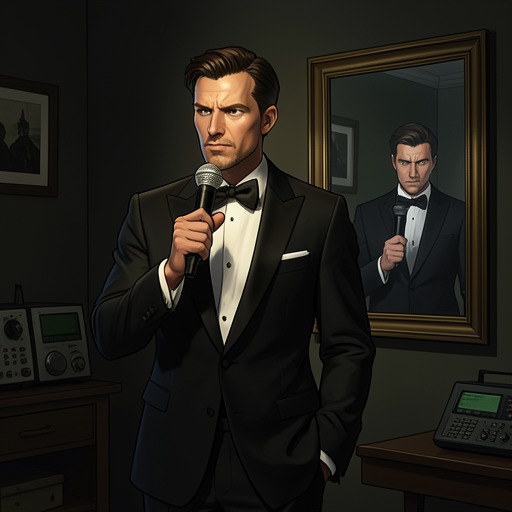
Johnny is presented first as a celebrity whose private life has become as disorderly as his public image is polished. In a Los Angeles hotel suite at four in the morning, he drinks scotch directly from the bottle while imagining that he might kill his wife, Margot Ashton, if she ever returns. He has become isolated by his own decline: former friends no longer welcome his late-night calls, and the women who once found his rise fascinating now belong to a world from which he feels himself slipping. Margot remains dazzlingly beautiful, an actress whose face commands the devotion of a hundred million men on screen, but her beauty also becomes a shield against Johnny’s anger and an instrument of his humiliation.
Their confrontation strips away the romantic persona attached to Johnny’s songs. He cannot strike Margot with real force, and she mocks both his violence and his sentimental understanding of sex and love before locking herself in the bedroom. Johnny is left on the floor in sick, humiliating despair. Yet the same toughness that helped him survive Hollywood prevents him from remaining helpless: he calls for a car, goes to the airport, and decides to return to New York. At the center of that decision is not merely a business contact but the one authority whose power and affection he still trusts, his Godfather Corleone.
Family Connection and the Appeal to Don Corleone
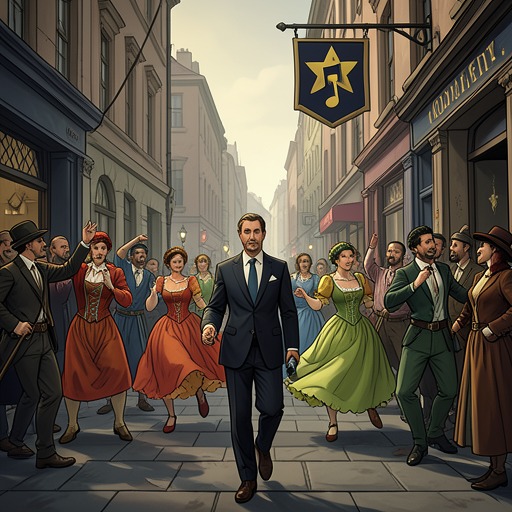
Johnny’s relationship with Don Corleone is older and deeper than his celebrity. He travels three thousand miles to attend Connie Corleone’s wedding, an act that the family reads as proper respect for his godfather despite his enormous fame. The guests are proud that one of their own has become a singer and movie star, and Johnny renews his old friendship with Nino Valenti, remembering the two of them singing together as boys before anyone imagined that Johnny would command the devotion of millions of women.
At the wedding, Johnny and Nino revive their mock musical battle, using their voices as if they were swords while Johnny lifts Connie onto the bandstand. Johnny deliberately allows Nino’s voice to overwhelm his own and lets him take the final victorious stanza. The gesture shows that celebrity has not entirely erased his older loyalties or his ability to honor another performer. Only Don Corleone notices that something is wrong beneath the celebration. He draws Johnny aside after greeting him publicly, and Johnny admits that he had believed the wedding invitation meant his godfather was no longer angry with him. He had repeatedly tried to reach Don Corleone after his divorce, but Tom Hagen had kept him away while the Don remained displeased.
Johnny’s appeal is a catalogue of failures. He explains that Jack Woltz had called him a Communist because of the songs he had performed for liberal organizations, though the accusation had not held. He had then slept with a woman Woltz had been grooming, married what he calls his whore of a second wife, been thrown out, and lost the welcome of his first wife, Ginny Fontane, and his children. Most devastatingly, he says that he can no longer sing. He asks what he can do, expecting pity, but Don Corleone answers with contemptuous affection rather than consolation.
The Don commands him to begin by acting like a man and repeats the rebuke with theatrical force. He grabs Johnny by the hair in a gesture that is both savage and loving, ridiculing his Hollywood self-pity and his habit of crying out for someone else to solve the consequences of his actions. The mimicry startles Johnny and Tom Hagen into laughter, and the laughter restores Johnny’s strength. Don Corleone then identifies the moral structure of Johnny’s predicament: Johnny took the woman of a more powerful employer, abandoned his family for a second marriage, failed to confront his wife because her beauty and career protected her, and now expects those he hurt to receive him without resistance. The intervention is not sentimental forgiveness. It is a forced return to responsibility, made possible because the Don loves him enough to attack his weakness directly.
Conflict with Jack Woltz and the Hollywood System
Don Corleone promises that Johnny will obtain a part in Jack Woltz’s film, and Tom Hagen carries the request to Hollywood. Woltz appears secure against the Corleone family. He possesses enormous wealth, national political connections, influence within the film industry, and an association with the FBI chief. The technical reach of the family empire does not extend beyond New York, and even the appointment itself seems designed to diminish Hagen: Woltz makes him wait and places him first on the schedule rather than inviting him to lunch.
Hagen nevertheless understands the bargaining structure clearly. Don Corleone offers to speak in Woltz’s favor during a labor dispute in exchange for Woltz’s support of Johnny. Hagen presents the arrangement as a friendly exchange of influence, not extortion. Woltz rejects that description and insists that Johnny will never receive the part because he hates him. The producer’s hatred is personal and irrationally bound to possession. He had invested hundreds of thousands of dollars and years of training in a young protege whom Johnny seduced, and he believes that Johnny made him look ridiculous by taking away a woman he regarded as both an investment and a sexual possession.
Woltz’s Hollywood differs sharply from the Corleone world. Hagen finds it difficult to understand that a powerful businessman would allow sexual jealousy and wounded vanity to determine a major professional decision. Within the Corleone code, women’s beauty and sexual power are treated as private matters except where marriage and family disgrace are involved. Woltz, by contrast, lets desire govern business and then disguises that desire as managerial necessity. Johnny’s conflict therefore exposes two systems of power that are different in style but alike in their capacity to treat people as property.
Woltz finally yields after a brutal private warning involving his prized racehorse, Khartoum. His servants and doctor are sworn to secrecy, the press is told that the horse died of an illness contracted during shipment from England, and the remains are ordered buried secretly on the estate. Six hours later, Johnny receives a telephone call from the film’s executive producer instructing him to report for work the following Monday. The call confirms that Don Corleone’s promise has been fulfilled, but it also makes clear that Johnny’s professional rescue has been purchased through a form of intimidation more terrifying than the ordinary exchange of favors Woltz first rejected.
Career, Voice, and Public Performance
Johnny’s career remains precarious even after he receives the part. When Tom Hagen later visits him at the Don’s direction, Johnny explains that the picture is finished and that the director treated him fairly. Woltz cannot simply remove Johnny’s scenes without damaging a ten-million-dollar film, so Johnny’s future depends on how audiences and the industry judge his performance. His concern has shifted from obtaining employment to winning public recognition, particularly the possibility of an Academy Award. The question reveals how deeply his identity remains tied to publicity, prestige, and the judgment of the entertainment industry that has humiliated him.
The culture surrounding Woltz’s studio intensifies that pressure. The Hollywood Movie Star Lonely Hearts Club meets every Friday in the home of Roy McElroy, the public-relations counsel of Woltz International Film Corporation. Woltz devised the gatherings to help aging stars find lovers and preserve the sexual fascination on which their careers depend. The parties are presented as professional events through the screening of new films, while their actual function is to arrange one-night encounters and possible longer sexual relationships. When the gatherings descend into brawls or excesses that might attract the police, McElroy is positioned to pay off newsmen and officers and keep the scandals quiet. Johnny’s career belongs to a system in which performance, publicity, sex, and controlled scandal are inseparable.
The most significant change in Johnny’s artistic life comes at the piano in Palm Springs. After a fight with Virginia, he cannot bring himself to make love to another woman, and he retreats to music. He has long treated the piano casually, picking out songs in a deliberately artificial ballad style, but now he begins to sing one of his old songs alone. He expects the familiar burning rasp in his throat, yet none comes. The voice is muted at first but has proper body; when he sings fully, he hears something darker and richer, a man’s voice rather than a boy’s.
Johnny does not initially want anyone to hear him. The closed glass door and Tina’s absence create a private space in which he can test a voice no longer governed by the expectations attached to his youthful fame. He finishes the ballad and sits thinking about what he has heard. Nino Valenti then enters and tells him that it is not bad, and Johnny is relieved that Nino, unlike the casual women and spectators around him, has heard him. The scene changes the meaning of his lost voice: what seemed only a professional disability becomes the possible emergence of a more mature instrument and a less manufactured self.
Relationships and Narrative Role
Johnny’s relationships are organized by competing forms of dependence. His first wife, Ginny Fontane, and his children represent a family life he abandoned and now wants restored on terms that would spare him humiliation. Margot Ashton represents the dangerous mixture of beauty, sexual power, celebrity, and contempt that defeats his romantic self-image. His friendship with Nino offers a different model: it reaches back to childhood, survives fame, and permits generosity, as when Johnny allows Nino to win their wedding-song contest and later accepts his judgment about the changed voice.
Tom Hagen occupies an uneasy middle position. Johnny resents Hagen for blocking his earlier attempts to reach Don Corleone, while Hagen regards that resentment as part of his role as a lightning rod for anger directed at the Don. Their coolness does not cancel Hagen’s loyalty; he travels to Johnny at the Don’s request to help him manage the next stage of his career. Johnny’s bond with Don Corleone is more complicated still. The Don protects him, disciplines him, and uses power on his behalf, but he refuses to let rescue become an excuse for continued childishness.
Johnny’s episodes also broaden the novel’s portrait of American power. His story moves between a drunken Los Angeles suite, a New York family wedding, the offices and estates of Hollywood, studio parties designed to manage aging stars, and the private piano in Palm Springs. Each setting exposes a different version of performance. Johnny performs romance in song, masculinity in marriage, authority in celebrity, and gratitude before the family, but these performances repeatedly fail until he confronts the voice and responsibilities beneath them. His narrative role is therefore not simply that of the singer whom the Godfather helps. He is a test case for the Godfather’s system of favors: an old personal bond becomes a promise, the promise becomes pressure, and the pressure restores a public career without necessarily resolving the private damage that produced the appeal.
Change and Thematic Significance
Johnny begins as a man who has converted success into entitlement and then collapses when the protections of beauty, fame, and charm stop working. His drunken fantasies of killing Margot, his inability to hurt her, and his despair on the floor reveal a masculinity built from performance rather than command. Don Corleone’s rebuke gives him a temporary moral center by forcing him to name his failures instead of asking to be comforted.
His professional recovery is correspondingly double-edged. The part in Woltz’s picture proves that Johnny can still be restored by the family’s reach, but it does not erase the fact that the restoration depends on threats and secrecy. Later, the discovery of a darker, fuller voice suggests a change that cannot be supplied by the Don alone. In the private act of singing, Johnny finds evidence that age and damage may have produced an artistic identity more substantial than the youthful crooner persona that made him famous.
The contrast between the studio’s artificial management of desire and Johnny’s solitary discovery at the piano gives his arc its final tension. Hollywood manufactures romance, youth, sexual availability, and public opinion; Johnny’s renewed voice appears when he is temporarily outside that machinery and singing for no audience. Yet the novel does not present him as fully transformed. He remains dependent on fame, vulnerable to vanity, and entangled in relationships he has damaged. His achievement is narrower and more credible: he regains work, receives the possibility of a new voice, and learns—under Don Corleone’s harsh protection—that a man cannot demand the privileges of family, power, and love while refusing the consequences of his own conduct.